
Introduction
In the fast-paced world of digital transformation, financial institutions are relying heavily on software systems to streamline operations, enhance customer experiences, increase revenue streams, and stay competitive. Two critical components in this ecosystem are middleware and platform solutions. Both play pivotal roles, yet serve different purposes and offer distinct functionalities. Before we can compare and contrast middleware and platform solutions we need a clear understanding of what each is. From there, we can delve into understanding their unique characteristics and how they can benefit your business.
Understanding Middleware
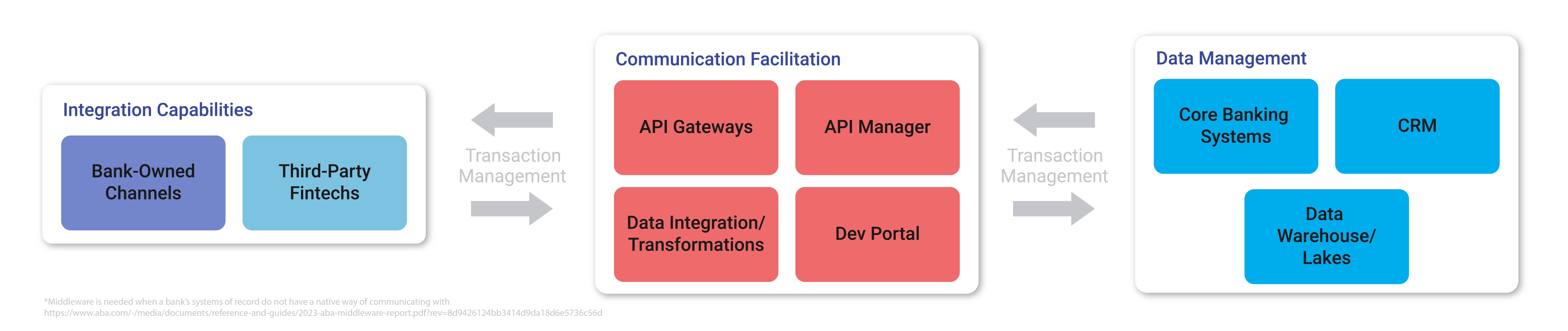
Middleware solutions are intermediary software systems that facilitate communication, data exchange, and integration between different banking applications and services. Middleware is needed when a bank’s systems of record do not have a native way of communicating with the various systems of engagement that bank employees and customers might use.They act as a bridge, enabling disparate systems to work together seamlessly by managing transactions, ensuring data consistency, and providing essential services such as messaging, authentication, authorization, and encryption. Middleware solutions are crucial in modern digital banking environments, as they help integrate legacy systems with new technologies, support microservices architectures, and enhance the overall interoperability and functionality of the banking ecosystem.
Core Features of Middleware:
- Integration Capabilities: Middleware connects disparate systems, allowing them to interact seamlessly.
- Communication Facilitation: Provides messaging services to enable communication between applications.
- Data Management: Handles data exchange and transformation.
- Transaction Management: Manages complex transactions across multiple systems.
- Security Services: Offers authentication, authorization, and encryption.
See Figure 1 - What is Banking Middleware?
Common Examples of Middleware:
- Message-Oriented Middleware (MOM): RabbitMQ, Apache Kafka
- Database Middleware: ODBC, JDBC, Informatica
- Application Servers: IBM WebSphere, JBoss, WebLogic, Mulesoft
- API Middleware: Boomi, TIBCO, Mulesoft
Understanding Platform Solutions
A platform solution is a comprehensive, integrated environment that provides all the necessary tools, services, and infrastructure for developing, deploying, managing, and scaling digital banking applications and services. It encompasses a wide range of functionalities, including development frameworks, runtime environments, security features, data management, and integration capabilities, to support an entire lifecycle of banking software.
The goal of a platform solution in digital banking is to streamline operations, enhance customer experiences, and ensure regulatory compliance while allowing banks to innovate and adapt to evolving market demands.
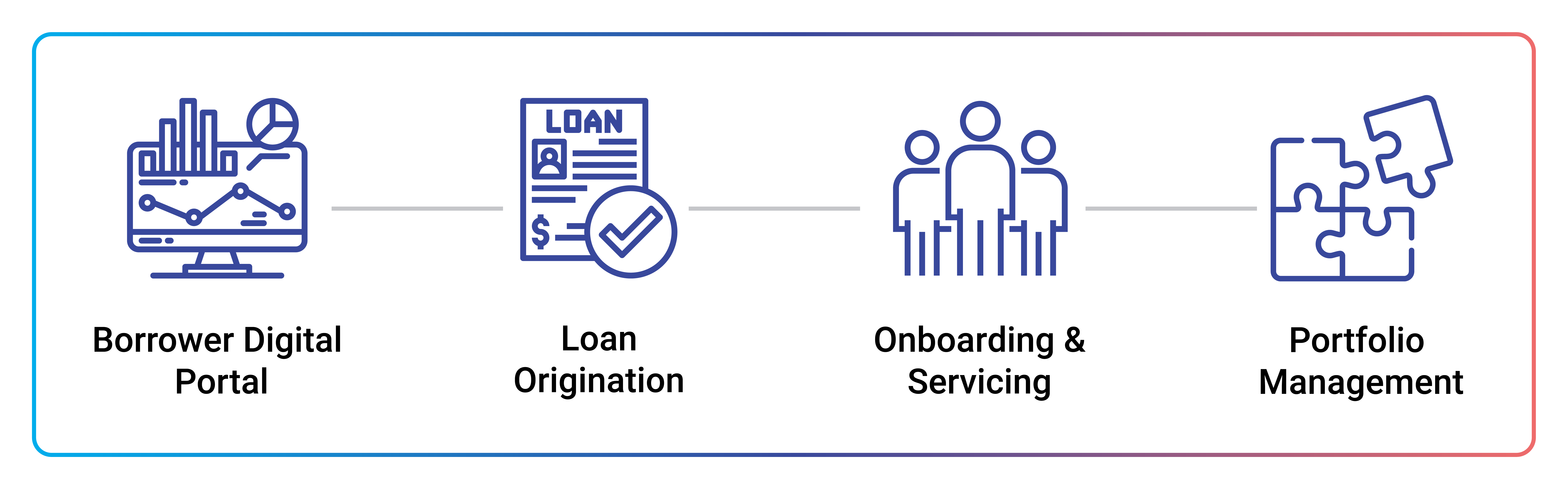
See Figure 2 Below - Sample Loan Origination Platform
Core Features of Platform Solutions:
- Development Tools: Includes SDKs, APIs, and other tools for software development.
- Runtime Environment: Provides the necessary infrastructure to run applications.
- Integration Tools: Often includes built-in middleware to facilitate integration.
- Management Tools: Offers tools for monitoring, scaling, and managing applications.
- Security Features: Ensures security at multiple levels, including application, data, and network security.
Figure 2 - Loan origination platform solution offered by Vikar
Common Examples of Platform Solutions:
- Cloud/Enterprise Platforms: Mambu, Vikar, nCino, Q2
- Development Platforms: Bankpoint, Appian, Pega
- Core Platforms: Fiserv, FIS, Finacle, Jack Henry
Key Differences Between Middleware and Platform Solutions
| FEATURE | MIDDLEWARE | PLATFORM BANKING SOLUTION |
| Scope | Broad, system-to-system integration | Focused on banking operations |
| Functionality | Data translation, routing |
Core banking, payments, CRM, etc. |
| Abstraction Level | Lower-level, technical | Higher-level, business-oriented |
| Relationship to Core Banking | Complementary | Often includes core banking capabilities |
| Role in Innovation | Enables agility, supports new integrations | Provides foundation for new product development |
Use Cases for Middleware and Platform Solutions
Middleware Use Cases:
- Integrating New Services with Legacy Systems: Middleware enables new applications to interact with older systems without requiring significant changes to the legacy infrastructure.
- Facilitating Communication in Microservices Architectures: Middleware helps manage communication between microservices, ensuring they work together efficiently creating a single source of truth for customer data.
- Managing Complex Transactions: Middleware handles transactions that span multiple systems, ensuring data consistency and integrity.
- Fostering Partnerships: Middleware helps create opportunities for banks to partner with best-of-breed fintech companies. Survey data collected by Finextra in 2019 found that 81% of banks globally view collaborating with fintech partners as the best strategy to achieve digital transformation.
Platform Solutions Use Cases:
Developing New Applications from Scratch: Platforms provide all the necessary tools and environments to build, deploy, and manage new applications.
Deploying and Managing Applications in the Cloud: Cloud platforms offer scalable infrastructure and integrated services for easy application deployment and management.
Leveraging Built-in Tools for Rapid Development and Scaling: Platforms often include pre-built tools and services that accelerate development and simplify scaling.
Pros and Cons of Each Approach
Pros of Middleware Banking Solutions
- Enhanced Integration: Middleware enables smooth integration of disparate systems, improving data flow and operational efficiency.
- Increased Flexibility: It offers flexibility to adapt to changing business requirements by easily integrating new systems or modifying existing ones.
- Improved Scalability: Middleware can handle increasing data volumes and transaction loads, ensuring system performance as the bank grows.
- Reduced Development Time: By providing pre-built connectors and adapters, middleware accelerates application development and reduces time-to-market.
- Cost-Effective: It can help optimize IT costs by reducing the need for custom integration solutions.
- Improved Data Quality: Middleware can help ensure data consistency and accuracy across different systems.
Cons of Middleware Banking Solutions
- Complexity: Implementing and managing middleware can be complex due to the need for configuration, customization, and ongoing maintenance.
- Performance Overhead: Middleware can introduce latency and performance overhead, especially when handling large volumes of data.
- Vendor Lock-In: Reliance on specific middleware vendors can limit flexibility and increase costs.
- Security Risks: Middleware can be a potential target for cyberattacks, requiring robust security measures.
- Steep Learning Curve: It may require specialized skills to implement and manage middleware solutions effectively.
Pros of Banking Platform Solutions
- Accelerated Time-to-Market: Pre-built components and APIs streamline development, allowing banks to introduce new products and services faster.
- Scalability: Platforms can handle increasing customer volumes and transaction loads, ensuring business growth.
- Cost Efficiency: By leveraging shared infrastructure and resources, banks can reduce operational costs.
- Enhanced Customer Experience: Platforms often include features for personalized customer interactions and omnichannel experiences.
- Innovation Catalyst: Platforms provide a flexible environment for experimenting with new business models and digital products like financial spreading.
- Data-Driven Decision Making: Platforms often incorporate advanced analytics capabilities to support data-driven strategies.
Cons of Banking Platform Solutions
- Vendor Lock-In: Reliance on a specific platform can limit flexibility and increase costs.
- Security Risks: Platforms handle sensitive customer data, requiring robust security measures.
- Customization Challenges: While platforms offer flexibility, achieving desired customizations may require significant effort.
- Potential for Legacy System Issues: Integrating legacy systems with a platform can be challenging.
Summary:
Middleware and platform solutions are both essential in modern software architecture, each serving unique roles. Middleware excels in enabling communication and data management between disparate systems, making it ideal for integration tasks. Platform solutions provide a comprehensive environment for developing, deploying, and managing applications, offering a broader range of tools and services..
When choosing between middleware and platform solutions, consider your specific needs, the complexity of your existing systems, and your future development goals. While middleware excels at connecting disparate systems, a platform provides a unified foundation for banking operations. This holistic approach accelerates product development, streamlines processes, and enhances customer experiences. Platforms often include pre-built functionalities, analytics tools, and scalability features, empowering banks to innovate rapidly and adapt to changing market demands. Unlike middleware, which primarily focuses on technical integration, banking platforms deliver a broader solution that drives business growth and efficiency.
About Vikar Technologies
Vikar is revolutionizing the way banks do business today. We are the only company providing software in which customers, lenders, branch managers, underwriters, KYC, and operation teams collaborate from a common interface across loans, deposits, treasury, and wealth management. Vikar offers One Vikar, a modern solution with built-in rules and automation supporting today’s demands from both bank clients and employees. The One Vikar solution is built with a holistic view of a bank’s business and completely integrates into the core banking system. The solution covers all business lines: retail, commercial and wealth management; and is available in all three service modes: self, joint and full service. For more information, visit www.vikartech.com




.png)

















.png)